If you’ve ever stood on a farm during the height of a sweltering Midwest summer, watching dairy cows pace restlessly in a barn or high-value nursery seedlings wilt under warehouse lighting, you’ve felt one of the quiet workhorses of modern agriculture: the agricultural AC compressor. As a supplier of these critical parts, I field this question every single day: “What’s the actual power consumption of an agricultural AC compressor?” And it’s not a one-size-fits-all answer—agricultural compressors don’t live in residential garages or office basements. They have to perform reliably in 100°F heat, dust storms, freezing winter snaps, and near-constant operation, all while helping farmers keep their animals, crops, and equipment healthy. Let’s break this down like we do when we walk a farmer through a quote, no jargon, just real-world numbers that matter for their bottom line. Agricultural AC Compressor
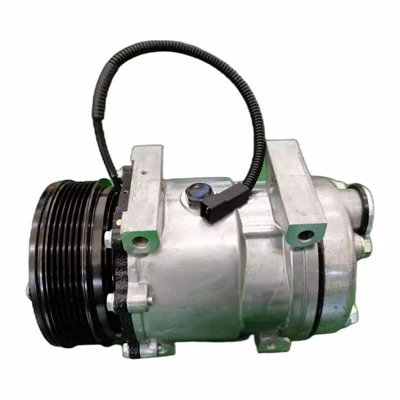
First, let’s get one thing straight: agricultural AC compressors aren’t built for the same small spaces as your home AC. A residential unit’s compressor runs a few hundred watts, but an agricultural one has to handle way larger loads. Let’s start with the basics. Power consumption here is measured in two key ways: starting power (that big surge when the compressor kicks on) and running power (the steady wattage it uses to keep cooling consistent). For small-scale operations—think a 10-cow dairy barn’s split AC unit or a small indoor herb nursery’s cooling setup—those compressors typically clock in between 1,500 and 3,500 watts when running. Starting power is a bit higher, usually 2 to 3 times that, so 3,000 to 10,500 watts for those small units. That makes sense for spaces under 1,000 square feet, right? A 10-cow barn doesn’t need to cool a football field, just a cozy spot where cows can rest, which this size handles perfectly.
But step up to a mid-sized operation, and the numbers shift fast. A 50-cow dairy barn, a commercial greenhouse, or a semi-truck’s refrigerated trailer used to haul fresh produce? Those compressors jump to 5,000 to 15,000 watts of running power. Starting power here hits 10,000 to 45,000 watts, and that’s where things get tricky for farmers. Farmers don’t have the same electrical infrastructure as a suburban home. Many older farm operations only have 200-amp service, and adding a mid-sized AC compressor means checking if their wiring can handle that surge without blowing fuses or tripping breakers. We run through that with every customer: we don’t just sell a compressor, we help them plan for their electrical load so they don’t end up with a costly service call mid-heatwave.
Now, let’s talk about the big players—large-scale commercial operations. A 500-cow free-stall barn, a multi-acre hydroponic farm’s climate-controlled warehouse, or a refrigerated grain storage facility? Those compressors are industrial, and their power consumption is on a whole different level. Running power here ranges from 20,000 to over 100,000 watts. Wait, that’s 100 kilowatts, right? Yeah, that’s the equivalent of powering 80 average American homes for an hour. Starting power for these units can exceed 200,000 watts, and that’s why we always recommend phase management for these setups. A lot of large farms use three-phase power, which handles big surges more efficiently than single-phase, so we’ll often suggest upgrading their service to three-phase if they haven’t already, because it cuts down on energy waste and extends the life of the compressor.
But here’s the part most farmers don’t realize: power consumption isn’t just about the size of the compressor. There are so many factors that change those numbers, and we see this every day in our warehouse when customers walk in with specific questions. First, climate. A compressor operating in Arizona’s 110°F summer heat has to work way harder than one in Minnesota’s 80°F summer, so its power use goes up 10-25% just to maintain the same temperature. We had a customer in Texas last year who thought his 10,000-watt compressor was broken because his power bill spiked $800 in July—turns out, the 105°F days meant his AC was running almost nonstop, which is normal for hot, dry climates. Second, load type. Cows need temperatures between 50 and 65°F to stay calm and produce milk, while leafy greens in a greenhouse need 60-75°F, and grain storage needs even more consistent, mild temps. A compressor running 24/7 to cool a 500-cow barn uses way more energy than one that only runs 8 hours a day to cool a small herb nursery. Third, compressor efficiency. Not all agricultural AC compressors are made the same. Some older, less efficient models waste 30-40% of their energy as heat, while modern high-efficiency units we sell cut that waste to 10% or less. That’s a huge difference in power bills—we had a dairy customer swap out an old 12,000-watt compressor for a 10,000-watt high-efficiency model, and his power use dropped by $1,200 a month in summer.
Another big factor many farmers overlook: cycling and duty cycle. Agricultural compressors don’t run nonstop—they cycle on and off to maintain temperature, which affects overall power consumption. A compressor with a 50% duty cycle (meaning it runs half the time) will use about half the power of one with a 100% duty cycle, all else equal. But if a compressor is too small for the space, it’ll run 100% of the time and still not cool properly, wasting energy and shortening its lifespan. That’s why we do a free load calculation for every potential customer—we measure their space, their animals or crops, their local climate, and their existing electrical setup to make sure they get a compressor that’s the right size, not too big or too small. We had a customer in Iowa last year who ordered a 15,000-watt compressor for his 30-cow barn because he thought “bigger is better”—he ended up returning it because it was cycling so frequently that it was costing him more in startup surges than it would have with a properly sized 5,000-watt unit.
Now, let’s get to the real-world numbers that matter for your power bill. Let’s do a quick example. Take a mid-sized dairy barn in Ohio, with a 8,000-watt running compressor, running 16 hours a day in July (the hottest month). The average commercial electricity rate in Ohio is about $0.12 per kilowatt-hour. That works out to 8 kW x 16 hours = 128 kWh per day, times 31 days = 3,968 kWh per month, times $0.12 = $476 a month. If you swap that for a high-efficiency 6,000-watt compressor? That’s 6 kW x 16 hours = 96 kWh per day, times 31 days = 2,976 kWh, times $0.12 = $357 a month—so you save $119 a month, almost $1,500 a year. That’s a new set of cow mattresses or a whole season of seed, right there.
But wait, what about startup costs? That’s where a lot of people get tripped up. When a compressor starts, it draws that big surge power to get the motor spinning, which can add up on your power bill if you have multiple compressors starting at the same time. For example, if you have two compressors, each drawing 10,000 watts of startup power, starting them at the same time would be a 20,000-watt surge that your electrical panel has to handle. If you stagger their startup, you cut that peak demand in half, which lowers your demand charges—those are the fees utility companies charge for your highest 15-minute power use each month, and they can add 20-30% to your total power bill for commercial operations. We always recommend stagger-start controls for customers with multiple compressors, and we include that in most of our mid and large-scale packages.
Now, let’s debunk a common myth I hear all the time: “Agricultural AC compressors use too much power for small operations.” No, not when sized and set up correctly. We recently installed a small split AC compressor for a 5,000-square-foot goat dairy in Vermont, which only uses 2,000 watts of running power. That unit runs 8 hours a day in summer, uses about $60 a month in power, and the goats’ milk production went up 12% because they were cool and comfortable. That’s a great return on investment, right?
At the end of the day, the power consumption of an agricultural AC compressor isn’t a random number pulled out of thin air—it’s dependent on your unique operation, your climate, your electrical setup, and the quality of the compressor itself. If you’re a small farmer just getting started with climate control for your animals, you’re looking at 1,500-3,500 watts. If you’re running a mid-sized greenhouse or dairy, that’s 5,000-15,000 watts. If you’re a large commercial operation with thousands of head of cattle or acres of hydroponic crops, you’re looking at 20,000 watts and up. And every single number we quote, every unit we sell, is tailored to what works for your farm—not a generic spec sheet.
If you’re tired of guessing what your compressor will cost to run, or you’ve been dealing with high power bills and inconsistent cooling, we can help. We don’t just sell agricultural AC compressors—we work with farmers of all sizes to do free load calculations, explain power needs, and find solutions that save you money while keeping your crops and animals healthy. To learn more about our products and get a custom quote for your operation, get in touch to connect with our team for a procurement discussion.
Agricultural AC Compressor References
ASHRAE. (2022). Agricultural Heating, Ventilating, and Air-Conditioning (HVAC) Applications. American Society of Heating, Refrigerating and Air-Conditioning Engineers.
US Department of Energy. (2021). Energy Efficiency Improvements for Agricultural HVAC Systems. Office of Energy Efficiency & Renewable Energy.
National Agricultural Statistics Service. (2020). Farm Energy Use Report: Climate Control for Livestock and Crops. US Department of Agriculture.
Jiangsu Nuoyan New Energy Vehicle Air Conditioning Co., Ltd.
With abundant experience, we are one of the most professional agricultural ac compressor manufacturers and suppliers in China. We warmly welcome you to buy customized agricultural ac compressor at competitive price from our factory. Also, quotation is available.
Address: No. 7 Xingyuan Road, Huangqiao Economic Development Zone, Taixing City, Jiangsu
E-mail: nuyantech2026@163.com
WebSite: https://www.nuyantech.com/
